skip to main |
skip to sidebar
I can't help but compare things to our last visit here. This time we spent our first night at the campsite area in Yulara . Yulara did not exist when we were here in 1988 - last time we camped in a swag on the ground. Yulara is a huge resort with accommodation for 6,000 – 3,000 camping, 3,000 hotel type rooms in a range of quality. It is basically a town with it's own grocery stores, post offices and more. Mike & I walked over to one of the bar areas where there was some entertainment. We tried to buy a beer, but had failed to bring our campsite receipt. Yulara is on aboriginal land (leased back to the government) and is a dry zone for the locals – so you need to prove you are a guest to buy a drink here. Luckily a lady who overheard my dilemma lent me her room key to allow us to buy a drink.
 But back to the days events....
  We rose semi early, had a quick brekkie and headed back to Uluru (the photos of Uluru are spread through this section in no particular order). We started at the cultural centre which was a maze of rooms and spaces where we managed to lose each other several times.
 From the centre we did the walk over to the rock rather drive. It is a different experience walking up to the rock rather than driving. When you are right below it, you cannot see the top and don't get the full appreciation of the size. When you walk up slowly, it looms before you (photo at right) and you get a much better sense of it's size as you realize how long it takes to get there, even when it seems like it
  is right in front of you.
 The large photo at right is the view of the rock as we approached. You can see the climbers (you will probably have to click on the photo and really look closely at the tiny white specks - those are people) making their way. I had already decided that I would definitely not climb this time, but honour the aboriginal request not to (and pamper my knees which even suffered 18 years ago).
  I was surprised how many people were still climbing given the very strong request from the aboriginals. Patrick was debating whether to climb, although he finally decided not to - and it turned out that the climb was just closed anyway due to high winds. So we all set off for the long walk.
 We have since discovered that the only real way to avoid the crowds is to do the 'long' walks. The bus masses do the short walks to say they’ve been there, but the long ones are only done by the independent travellers like us.
 It was very nice to do the walk all the way around the rock. It was something totally different from our last visit (we only did a little bit last time), and the views as you travel around are quite varied (photos through this section).
  One of the features we came across looked a lot like 'Wave Rock' (photoed here)- a site we likely not see here in WA since it is difficult to get to.
There are numerous stories regarding different sections of the rock. The rock is believed to be the home of the Rainbow Serpent - the mother of all life to all aboriginals. Uluru is where she created all life, and the stories around the rock relate to that creation. If you want to read a bit of the aboriginal story, check out http://www.ace.net.au/darkmoon/rainbow.htm.
 There are many areas where you are asked not to photograph as they are of significance to the aboriginals – and they still use them as meeting places.
  You are able to photo some of the paintings however as seen here. It is considered acceptable to paint over top of someone else's art, but not to repaint it. So the areas where painting is done (such as in caves or underhangs) have become quite 'crowded' . The aboriginals have been here for up to 50,000 years it is believed.
It was a long walk, and took us till mid afternoon – even with the short cut over the road (when we weren’t quite sure we were going the right way).  By the time we returned to the camper, had lunch and drove over to Kata Tjuta (the Olgas), we did not have time for the full long walk. (remaining photos are of Kata Tjuta)
 It was very interesting although crowded – and again something we had not done last time. The walk was very bumpy however and hard on the feet. Both Mike and I had throbbing feet by days end – and the boys were apparently pretty zonked too given how late they slept the next morning!

The rock at Kata Tjuta is again sedimentary, but not the same as Uluru. Uluru is homogeneous with no jointing and is made of a coarse grained sandstone with an abundance of feldspar. Here, the rock is conglomerate with a variety of basalt, and granite all mixed with a finer sandstone. As a result, the erosion has occurred differently resulting in the 'many heads' of Kata Tjuta.
 Then it was the long drive out to Curtin Springs for our second campsite. As on the west coast, you have to be careful driving at dusk and dawn - with new dangers. En route we passed some camels eating at the road side – one male and his harem of 3 or 4 females. He was right on the road at times (we stopped), and boy was he big! We passed a solo one later on also, but that was it. At Curtin Springs we had dinner and then watched Austin Powers (bought in Alice) – at least those who could stay awake watched!
The anticipation at the start of a trip is always much more exciting to experience than to review, but for those interested, I'll start with the back story of getting to Uluru (Ayer's Rock). Friday brought Mike & Pat home.  Mike was exhausted from Country Week since he was on supervisory duties each night until all the students settled down then was up very early to head off to the games. He photoed other Pinjarra teams as well as coaching the girls basketball team, so his days were full. The girls team played very respectably, and all were pleased with their convincing 3rd place finish in a challenging division.
  Had they scored a single point more in the semi-final they would have been in the grand final - against a team that had met and lost to by a single point. Here are 2 (wow a record!!!) shots of Mike - one after their successful win for 3rd, and another with a fellow teacher / volleyball coach - wearing one of the gifts from the team (he also received an Aussie flag signed by the team and a basketball).We had a bit of a scramble to get Mike a tripod on Saturday morning as Patrick had left a critical piece behind at Gingin. Mike ended up with a new tripod, which isn't so bad since the old one was about 20 years old and missing some newer features. The scurry had us leave a little later than planned, and we arrived at the airport to extreme crowds - having to park in the 3rd or 4th level of overflow parking. Luckily the airline opened up express lanes for imminent flights and we managed to get checked in just in time for our flight to Alice Springs. No Worries!
 Alice itself seemed quite similar to our last visit in 1988. Although definitely bigger, it still had the same character, and the residents were just as friendly. People seem to come here to visit and just never get around to leaving. Many people you speak to have been there for 5, 10 or 15 years and had never really had planned on staying, but they just love it there. Saturday evening we stayed at a hostel and the hosts very kindly drove us to the 'Overlander Steakhouse'. We are almost positive that this is the same restaurant where we shared a fantastic (for 3 of us at least) meal with Dan & Suz so many years ago (with Dan's infamous miniature buffalo steak :-). Although witchetty grub soup is no longer available, we did share an appetizer plate of Emu (quite good - bit oily), Crocodile (bit fishy), Kangaroo (better than WA roo we thought) and Camel (the least favourite for all of us, but still tasty). We all had beef of varying cuts. The portions were large and the accompaniments superb, however each of the 4 different cuts were a bit disappointing given the reputation of Aussie beef. Apparently the very best cuts now are exported, especially to Japan since they can draw such huge profits. Too bad since the beef we had here last time was superb.
 We then headed to Coles to do our groceries for the trip to Uluru in the morning. In the morning Mike & I rose early to go get the camper van while the boys were spoiled with a late lie. Mike managed to drive back to the hostel very smoothly despite the size of the beast. It was a bit older than we had hoped for and showing it's age, but very roomy with a cooktop, microwave, fridge, TV with DVD, 2 indoor tables, toilet/shower/sink, toaster,
  kettle and running hot & cold water. It was a bit later than we hoped by the time we set off, and it was a long drive, so off we headed to try to catch the sunset at Uluru!The drive was long, but with a speed limit of 130km per hour, we could travel as fast as we wished (which was NOT 130km in Beast). This area is not full out desert, but covered in sparse scrubby vegetation as you can see by a shot from the window.
  The first giant formation you come to is not in fact Uluru, but Mount Conner (859m). It is substantially larger than Uluru (348m), but not as much of an attraction. Uluru is more interesting due to it's changing vision in the light, and it's monolithic presence.We made it to sunset over Uluru just in time.
 We ate our dinner watching the subtle colour changes.
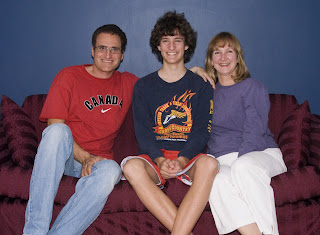
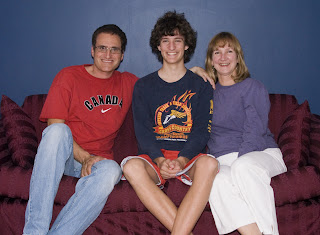
  If you peek through to see the colour of Uluru in our family photo here, you can see the difference of the rock colour from the other photo here.Then it was off to Yulara to check into our campsite for the night before returning for a true visit to the Rock tomorrow.
 But back to the days events....
  We rose semi early, had a quick brekkie and headed back to Uluru (the photos of Uluru are spread through this section in no particular order). We started at the cultural centre which was a maze of rooms and spaces where we managed to lose each other several times.
  From the centre we did the walk over to the rock rather drive. It is a different experience walking up to the rock rather than driving. When you are right below it, you cannot see the top and don't get the full appreciation of the size. When you walk up slowly, it looms before you (photo at right) and you get a much better sense of it's size as you realize how long it takes to get there, even when it seems like it
  is right in front of you.
 The large photo at right is the view of the rock as we approached. You can see the climbers (you will probably have to click on the photo and really look closely at the tiny white specks - those are people) making their way. I had already decided that I would definitely not climb this time, but honour the aboriginal request not to (and pamper my knees which even suffered 18 years ago).
  I was surprised how many people were still climbing given the very strong request from the aboriginals. Patrick was debating whether to climb, although he finally decided not to - and it turned out that the climb was just closed anyway due to high winds. So we all set off for the long walk.
 One of the features we came across looked a lot like 'Wave Rock' (photoed here)- a site we likely not see here in WA since it is difficult to get to.
 There are many areas where you are asked not to photograph as they are of significance to the aboriginals – and they still use them as meeting places.
  You are able to photo some of the paintings however as seen here. It is considered acceptable to paint over top of someone else's art, but not to repaint it. So the areas where painting is done (such as in caves or underhangs) have become quite 'crowded' . The aboriginals have been here for up to 50,000 years it is believed.
  By the time we returned to the camper, had lunch and drove over to Kata Tjuta (the Olgas), we did not have time for the full long walk. (remaining photos are of Kata Tjuta)
 It was very interesting although crowded – and again something we had not done last time. The walk was very bumpy however and hard on the feet. Both Mike and I had throbbing feet by days end – and the boys were apparently pretty zonked too given how late they slept the next morning!

 Then it was the long drive out to Curtin Springs for our second campsite. As on the west coast, you have to be careful driving at dusk and dawn - with new dangers. En route we passed some camels eating at the road side – one male and his harem of 3 or 4 females. He was right on the road at times (we stopped), and boy was he big! We passed a solo one later on also, but that was it. At Curtin Springs we had dinner and then watched Austin Powers (bought in Alice) – at least those who could stay awake watched!